Skip to content
Spice Buying Guide

What's Actually in Your Spice Rack?

Most grocery spices are blended from multiple origins, aged in warehouses, and sold without a harvest date. Ours are single origin, lab-tested, and traceable to the farmer who grew them. This guide will help you understand the difference and find the right spices for your kitchen.

What Are You Looking For?

Tell us what matters to you, and we'll point you to the right spice.

Every Spice We Carry

Lakadong Turmeric
India · Meghalaya
Lakadong Valley, Jaintia Hills
Curcumin: 7.61%
vs Grocery: 2–3% (3–4x less)
Weight: 48g jar
Price: $11.00
Curcumin potency

Lakadong Turmeric

The highest curcumin turmeric in the world. Lab-tested proof on every jar.

Named after the village where it grows in Meghalaya's Jaintia Hills. This isn't a marketing claim — Lakadong is a specific variety of Curcuma longa that produces curcumin levels three to four times higher than standard turmeric, and it only achieves those levels in this valley's volcanic soil and monsoon climate. Attempts to grow Lakadong rhizomes elsewhere have consistently failed to replicate the potency.

Each rhizome is sliced by hand and sun-dried slowly to preserve the deep golden color. No fertilizers, no pesticides — just mountain soil and knowledge passed down through generations. You'll know the difference the moment you open the jar: the color is a deep, saturated gold, and the aroma fills the room.

Earthy Warm Peppery Deep gold color
Use it in: Turmeric wellness shots, golden milk lattes, curries, scrambled eggs, roasted cauliflower, smoothies. Always pair with black pepper — piperine increases curcumin absorption by up to 2,000%.
Meet Edwina Lamare, your turmeric farmer
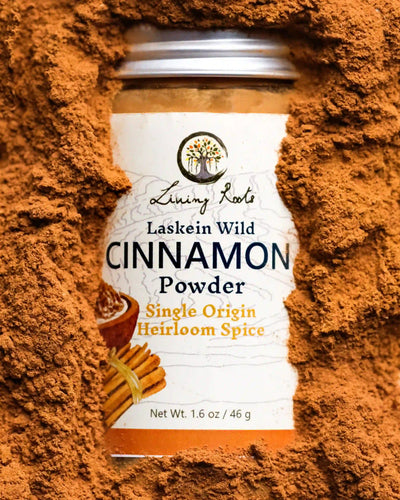
Laskein Wild Cinnamon
India · Meghalaya
Laskein, Jaintia Hills
Volatile Oil: 2.17 ml/100g
vs Grocery: 0.5 ml/100g (4x less)
Weight: 2 oz jar
Price: $11.00
Volatile oil potency

Laskein Wild Cinnamon

Wild-foraged from ancient forests. 4x the aroma of grocery cinnamon.

This cinnamon is not plantation-farmed. It's harvested from trees growing naturally in the ancient forests of Laskein by indigenous foragers who've been doing this for generations. Most grocery "cinnamon" is mass-produced Cassia, optimized for cost, not flavor. Ours is wild-foraged, single-origin, and lab-tested.

The volatile oil profile — cinnamaldehyde for warmth, eugenol for depth, linalool for floral sweetness — is what separates real cinnamon from the flat, one-note cassia that dominates shelves. At 4x the industry minimum, a little goes much further.

Sweet cedar Wild honey Warm Complex
Use it in: Apple pie cinnamon cupcakes, oatmeal, coffee, chai, roasted sweet potatoes, stews. Elevates desserts and deepens savory dishes.
Meet Ribaitki Langstang, your cinnamon forager
Ing Makhir Ginger Powder
India · Meghalaya
Sahsniang, Jaintia Hills
Volatile Oil: 2.71 g/100g
vs Grocery: 1.0 g/100g (3x less)
Weight: 2 oz jar
Price: $12.00
Volatile oil potency

Ing Makhir Ginger

A distinct species. GI-tagged. Fiery, citrusy, and nearly 3x the potency.

Ing Makhir isn't regular ginger. It's a distinct species — Zingiber rubens — with a GI (Geographical Indication) tag, the same certification that protects Champagne or Darjeeling tea. It only grows in Meghalaya's Jaintia Hills, and its fiery, citrusy profile is nothing like the mild, slightly woody ginger on most shelves.

Research shows Ing Makhir is rich in phenolics, flavonoids, and alkaloids with strong antioxidant properties. Planted in April, tended through the monsoon, harvested in late December through February when its natural oils peak.

Fiery Citrusy Sharp Aromatic
Use it in: Chai, soups, stir-fries, marinades, turmeric wellness shots, baking. A little goes a long way — this ginger is potent.
Meet Shilda Bhoi, your ginger farmer
Tura Black Pepper
India · Meghalaya
North Garo Hills
Cultivation: Rainforest canopy
Harvest: Heirloom vines
Weight: 2 oz jar
Price: $11.00

Tura Black Pepper

Rainforest-grown, heirloom vines. Bold heat with aromatic depth.

In the Garo Hills, pepper vines climb rainforest trees — not poles on a plantation. The trees give the vines natural support, and in return the vines develop a depth of flavor that plantation pepper can't match: bold, warm, with an aroma that's noticeably more complex than the flat heat of commodity peppercorns.

Beyond flavor, black pepper is the essential partner for turmeric. Piperine — the compound that makes pepper spicy — increases curcumin absorption by up to 2,000%. That's why we sell them together as the Gold & Fire Duo.

Bold Warm Aromatic Complex heat
Use it in: Crispy black pepper tofu, cacio e pepe, fresh-cracked over eggs, finishing steaks, golden milk alongside turmeric.
Meet Dimse D. Shira, your pepper farmer
Pampore Saffron
India · Kashmir
Pampore
Crocin: 8.7%
Grade: Premium threads
Weight: 1g
Price: $15.00
Crocin potency

Pampore Kashmir Saffron

Kashmir's red gold. Hand-picked at dawn from a third-generation farm.

Saffron is the world's most expensive spice because harvesting it is absurdly labor-intensive. Each crocus flower produces exactly three stigma threads, each hand-picked at dawn when the aroma is strongest. It takes roughly 75,000 flowers to produce a single pound.

Avi Koul is a third-generation farmer in Pampore — Kashmir's saffron capital. His threads test at 8.7% crocin, the compound responsible for saffron's deep color, sweet fruity flavor, and researched health benefits. If saffron seems cheap, it's fake — counterfeit saffron is rampant. Real saffron has deep red threads with orange tips, a complex honey-like aroma, and bleeds color slowly in warm water.

Sweet Fruity Honey-like Floral
Use it in: Rice dishes (steep threads in warm water first), mango saffron pudding, saffron shortbread cookies, tea. A few threads go a long way.
Meet Avi Koul, your saffron farmer
Coorg Cardamom
India · Coorg
Madikeri Hills, Western Ghats
Form: Whole pods
Estate: 5th-generation farm
Weight: 1.5 oz
Price: $11.00

Coorg Cardamom

Whole pods from a fifth-generation estate in India's spice country.

Coorg cardamom grows in the tropical rainforests of the Western Ghats — a biodiversity hotspot and one of the world's great spice-growing regions. The pods are intensely aromatic with a sweet, herbal, pine-like complexity that standard cardamom doesn't approach.

Raghu Chikkanahalli is a fifth-generation farmer who left a career in tech to return to his family's traditional profession: sustainable farming. His cardamom is whole-pod, preserving the volatile oils that pre-ground cardamom loses within weeks of processing. The world's third most expensive spice after saffron and vanilla — and the quality gap between fresh pods and old powder is enormous.

Sweet Herbal Pine-like Intensely aromatic
Use it in: Chai, biryanis, rice dishes, pastries, cardamom rose butter cookies. Crush a pod into coffee grounds before brewing for a Middle Eastern twist.
Meet our farmers

Side-by-Side Comparison

Every spice at a glance — potency vs grocery, flavor profile, best uses, and price.

Spice comparison by potency, flavor, best use, and price
Spice Flavor Potency vs Grocery Best For Price
Lakadong Turmeric Earthy, warm, peppery 3–4x Wellness, curries, golden milk $11
Wild Cinnamon Sweet cedar, honey, warm 4x Baking, oatmeal, coffee, chai $11
Ing Makhir Ginger Fiery, citrusy, sharp 3x Stir-fries, chai, tonics, baking $12
Tura Black Pepper Bold, warm, complex Heirloom Everything. Turmeric absorption. $11
Pampore Saffron Sweet, fruity, honey 8.7% crocin Rice, desserts, tea, special dishes $15
Coorg Cardamom Sweet, herbal, pine Whole pod Chai, rice, baking, coffee $11

Build Your Pantry

You don't need all six at once. Here's how to think about stocking a kitchen with spices worth cooking with.

The Foundation

Start With Three

These cover the widest range of cooking and wellness uses.

Turmeric — the wellness anchor
Black Pepper — unlocks turmeric, finishes everything
Cinnamon — baking, drinks, savory depth
Add Range

The Fourth Spice

Ginger fills the gap between sweet and savory cooking.

Ginger — stir-fries, marinades, baking, tonics
4 spices qualifies for free shipping
The Full Kitchen

Special Occasions

The luxury tier. Ingredients where quality is the entire point.

Saffron — transforms rice, desserts, teas
Cardamom — elevates chai, pastries, biryanis

Storage & Freshness

Proper storage is the difference between spice that performs and spice that fades.

The Basics

Keep jars sealed in a cool, dark cabinet away from heat and moisture. Never store spices above the stove or next to the oven — heat degrades volatile oils faster than anything else. Our glass jars seal well, but transfer to an airtight container if you prefer.

Shelf Life

Ground spices are best used within 6–12 months of opening for peak aroma and flavor. Whole pods (cardamom) last longer — up to 18 months. All our jars include a harvest date and packaging date so you know exactly how fresh your spice is. If it doesn't smell like anything when you open it, it's time to replace.

Saffron Storage

Saffron is more delicate than ground spices. Store threads in the original container, away from light. Properly stored saffron maintains potency for 2–3 years. Never buy pre-ground saffron — it's almost always adulterated.

The Nose Test

Quality spice should hit you with aroma the moment you open the jar. If you have to put your nose directly into the jar to smell anything, the spice has lost its volatile oils and most of its flavor. That's the grocery shelf problem — by the time it reaches you, the potency is already gone.

Frequently Asked

What does single-origin mean for spices?
Every spice comes from one farm, one harvest, one region. Nothing is blended from multiple sources. You can trace each jar to the farmer who grew it, the village where it was harvested, and the date it was processed. This ensures consistent quality and measurable potency — unlike commodity blends where origins are mixed and quality varies batch to batch.
Why are your spices more expensive than grocery store brands?
Grocery spices are commodity blends optimized for the lowest cost. Our spices come from specific farms with exceptional terroir, are harvested at peak season, and lab-tested for potency. The measurable difference: our turmeric has 3–4x the curcumin, our cinnamon has 4x the volatile oil. You use less because the spice actually works, which makes the cost per use comparable — with dramatically better results.
How do I know your spices are authentic?
Every batch is tested at government-approved labs (NABL-accredited in India) and results are published on each product page. Our jars include harvest dates, packaging dates, and the farmer's name. We source directly from farms — no middlemen, no blending, no mystery. You can visit the farmer profiles to see exactly who grows your food.
Are your spices organic?
Our spices are organically grown — no pesticides, no fertilizers, no GMOs. However, they are not USDA certified organic. Organic certification is expensive and logistically difficult for small, remote farmers in Meghalaya and Kashmir. We invest in lab testing instead, which we believe gives you more useful information: actual curcumin content, volatile oil levels, and contaminant screening.
Why should I pair turmeric with black pepper?
Piperine in black pepper inhibits the liver enzymes that normally break down curcumin before your body can absorb it. Research shows this increases curcumin bioavailability by up to 2,000%. Without pepper, most of the curcumin passes through unused. A healthy fat (coconut oil, ghee) also helps absorption. Our Gold & Fire Duo pairs them together for this reason.
How long do the spices last?
Unopened, our ground spices maintain peak quality for up to 2–3 years from the harvest date. After opening, use within 6–12 months for optimal potency and aroma. Whole cardamom pods last longer — up to 18 months. Saffron threads, properly stored away from light, maintain quality for 2–3 years. All jars are marked with harvest and packaging dates.
Do your spices contain any additives or fillers?
No. Every spice is 100% pure, single-origin, non-GMO, and lab-tested for contaminants including heavy metals and microbiology. No added colors, no fillers, no anti-caking agents. What's on the label is what's in the jar.
Which spices should I buy first?
Start with turmeric, black pepper, and cinnamon. These three cover the widest range of cooking and wellness uses, and they work well together. Add ginger for range across savory and sweet. Saffron and cardamom are for when you're ready to elevate specific dishes. See our Build Your Pantry section above for the full progression.

Ready to Taste the Difference?

Every jar ships with a harvest date, farmer name, and lab-tested purity. Flat $3 shipping, free over $49.

Shop All Spices Start With the Duo