Your cart is empty.
Have an account? Log in to check out faster.

We don't sell spices and teas. We return them to you the way they were meant to be — fresh from the harvest, alive with flavor, carrying the story of the hands that grew them.
Everything we do starts with a simple conviction: if you knew what was possible — the depth a turmeric could reach, the complexity a high-mountain oolong could hold — you'd never go back to what's on the shelf.
Four commitments guide every decision we make — from which farms we partner with, to how we package what they grow, to what we're willing to show you.

Most turmeric on the shelf has 2–3% curcumin. Ours has 8%. Our Kashmir Saffron carries 8.7% crocin. Our Taiwan High Mountain Oolong is grown above 1,000 meters, where thin air and cool nights concentrate flavor compounds that lowland tea simply can't match.
These aren't marketing numbers. They're lab-verified. They're the reason a quarter teaspoon of our turmeric does what a tablespoon of theirs can't.
We built a company around freshness because freshness is where potency lives. The closer your spice is to harvest, the more it gives you — more aroma, more color, more of the compounds that actually matter for your health.

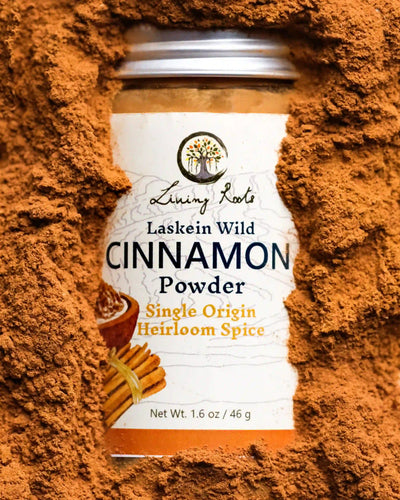
Your spices arrive in borosilicate glass — the same material used in lab equipment. Inert, non-leaching, endlessly reusable. Your teas come in biodegradable kraft tubes. Even the spoons are carved from neem and bamboo.
Every jar carries a colophon: a hand-drawn illustration inspired by the land where your spice was grown. It's a small thing, but small things are where care shows.
100% plastic-free. Water-based inks. No film wraps, no foam inserts, no compromises dressed up as "eco-friendly." We designed packaging to actually be sustainable — and beautiful enough that you'd want to keep it on your shelf long after the last pinch.

Edwina Lamare grows turmeric on fewer than five acres in Meghalaya. Dmise DShira cultivates pepper beside a rainforest still home to India's last Hoolock Gibbons. The Shen family has been growing tea in Taiwan since 1978.
We chose farmers like these — not because "small batch" looks good on a label, but because their methods produce something industrial farming cannot. Hand-harvested at peak maturity. Sun-dried or precision-processed to protect volatile oils. Varieties chosen for flavor and heritage, not shelf life and yield.
Many of these farms are women-led or minority-owned. Some use cultivation techniques passed down across three, four, five generations. The result is turmeric that stains your hands, saffron you can smell through the jar, and tea with a complexity that unfolds across five steeps.
These aren't suppliers. They're the people we're building a future with.
The global spice trade has a problem it doesn't like to talk about. Adulteration. Lead-laced turmeric. Pesticide residues. Fillers blended in to cut costs. Most of this is invisible to the consumer — by design.
We test every batch at government-approved laboratories and publish the results on our website. Not a summary. Not a badge. The actual lab reports — heavy metals, pesticides, microbial counts — on every product page, for every spice and tea we sell.
Every package shows the harvest date and the name of the farmer who grew it. No middlemen. No mystery. You can trace what's in your kitchen all the way back to the soil it came from.
If a company can't show you the proof, you should wonder what they're not showing you.
We're not trying to reinvent the spice aisle.
We're trying to make it honest again.