Your cart is empty.
Have an account? Log in to check out faster.


A lot of turmeric on store shelves is not telling you the full truth.
Some of it is weak. Some of it is padded with fillers. And some, which still bothers me, is artificially dyed to look potent when it is not.
When we started sourcing turmeric seriously for Living Roots, I learned something most people never hear. Curcumin content can vary wildly, from as low as 2 percent to over 7 percent, depending on where and how the turmeric is grown. Curcumin is the compound everyone actually wants. It is responsible for turmeric’s deep color and most of its benefits.
That discovery sent me down a rabbit hole. Along the way, I learned a few simple, old school tests that farmers and spice traders have used for generations. No lab coat required. No fancy equipment. Just your senses, a little chemistry, and curiosity.
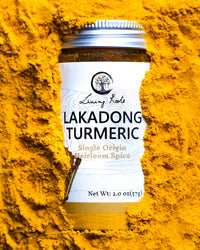
Today, I want to show you how to test turmeric at home and why our Lakadong turmeric, with about 7 percent curcumin, behaves completely differently than the 2 to 3 percent turmeric most of us grew up with.
Let’s talk about the elephant in the room. Color.
High curcumin turmeric is not just yellow. It has a deep, warm reddish orange undertone, almost brick-like when you pile it up. Lakadong turmeric from Meghalaya, India is famous for this. When you compare it side by side with standard grocery store turmeric, the difference is honestly shocking.
That's right, brighter yellow does not mean better turmeric. In fact, sometimes it means the opposite.
Some suppliers add artificial yellow dyes to make low curcumin turmeric look vibrant. These dyes do not behave like real curcumin. They do not stain the same. They do not react the same. Once you test for it, the illusion falls apart fast.

This is the test that made me say “oh wow” the first time I tried it.
Curcumin is alkaline reactive. When it meets a base like baking soda, it changes color, shifting from yellow or orange to a deeper reddish brown. Artificial dyes usually do not react at all.
What you need
Step by step
What you will see
Pure, high curcumin turmeric: The color deepens dramatically into a reddish brown, almost rust-like shade.
Low quality or dyed turmeric: Little to no change, or a dull muddy color.
When we run this test with our Living Roots Lakadong turmeric, the reaction is immediate and intense. With typical store bought turmeric, it is often underwhelming. Sometimes nothing happens at all.
That contrast alone tells you a lot.

This one surprised me because it is so simple and so revealing.
What you need
Step by step
Results
Here is why this works. Real turmeric powder is relatively heavy. Fillers are lighter and disperse quickly. This test will not catch everything, but it catches more than you would expect.
I learned this one from a spice merchant who laughed and said, “Your skin knows.”
Step by step
Results
High curcumin turmeric: Leaves a deep yellow stain that lingers.
Low quality turmeric: Washes off easily or leaves a dull, powdery residue.
Lakadong turmeric stains like it means business. That is curcumin doing what it does best.
This part is not fun, but it matters.
Metanil Yellow is a synthetic dye sometimes illegally used to enhance turmeric color. It is toxic and absolutely not something you want in your food.
The test
Adding a strong acid such as hydrochloric acid to turmeric powder.
Results
Pure turmeric: No dramatic color change other than the normal yellow to orange shift.
Metanil Yellow present: Turns pink immediately.
Most people will not perform this test at home, and that is completely fine.
Most commercial turmeric falls around 2 to 3 percent curcumin. That is the industry norm.
Lakadong turmeric averages 6 to 9 percent curcumin. Ours consistently tests around 7 percent.
That difference shows up everywhere.
Nature did the heavy lifting here.

When we line up photos of standard store bought turmeric, artificially dyed turmeric, and our Lakadong turmeric, the difference is unmistakable.
One looks pale.
One looks neon.
One looks deep, earthy, and naturally red.
Your eyes are not lying to you.
If you already have turmeric at home, test it. Seriously. Make this a five minute experiment. You will learn more than any label could ever tell you.
If you want to experience what real, high curcumin turmeric tastes like and how it behaves, try our Living Roots Lakadong turmeric. Use less. Notice the color. Notice the staining. Notice the reactions.
That is not marketing. That is chemistry and tradition lining up.
Try it in golden milk, curries, or even warm water with black pepper. Compare it side by side with what you already have. Run the tests yourself.
Once you do, you will never look at turmeric the same way again.
| Test | Method | Pure Result | Adulterated Result |
|---|---|---|---|
| Water Test | Add a teaspoon to a glass of lukewarm water. Do not stir. | Settles at the bottom; water remains clear/pale yellow. | Settles, but the water becomes cloudy or dark yellow. |
| Palm Test | Rub a pinch on your palm with your thumb for 20 seconds. | Leaves a deep, bright yellow stain on the skin. | Washes off easily or leaves a dull/powdery residue. |
| Metanil Yellow | Add strong acid (like HCl) to the powder. | No change (except the normal yellow-to-orange). | Turns pink immediately (indicates toxic chemical dyes). |
Sourced directly from family farms. Pure, authentic, and full of story.
Shop Our Collection