Your cart is empty.
Have an account? Log in to check out faster.

Poached pears are one of the simplest elegant desserts you can make. Peeled whole pears go into a pot of simmering honey syrup infused with saffron, cardamom, star anise, rose water, orange peel, and salt. They cook gently for about twenty minutes, getting basted and turned every five minutes so they absorb the syrup evenly. The pears come out tender all the way through, golden from the saffron, and perfumed with every aromatic in the pot. The syrup gets reduced by half after the pears come out, concentrating it into a glossy, honey-thick sauce. Served halved or whole over a dollop of Greek yogurt, with the reduced syrup poured over the top and a few thyme leaves scattered on, the whole thing takes about 40 minutes and looks like it came out of a restaurant kitchen.
The technique is slow, gentle simmering. The pears should never boil. Boiling breaks down the surface too fast, turning the outside to mush while the core stays hard. A bare simmer, with the syrup just barely moving, cooks the pears evenly from the outside in and lets the aromatics penetrate deep into the fruit rather than just flavoring the surface. Basting and turning every five minutes ensures all sides spend equal time submerged. The lid stays on between bastings to trap the steam and cook the exposed tops. After twenty minutes, a paring knife should slide into the thickest part of the pear with no resistance. If there's still a firm core, give it another five minutes.
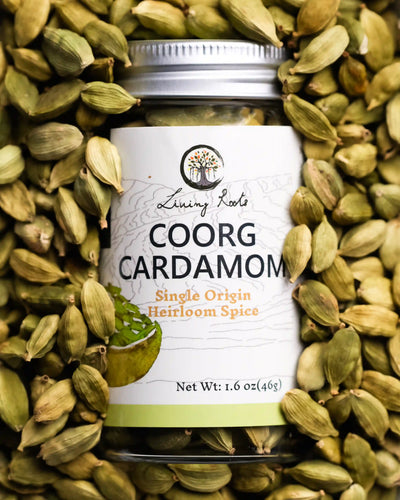
This recipe uses Pampore Kashmir Saffron and Coorg Cardamom. The saffron threads go directly into the cold syrup at the start, giving them the full twenty-minute simmer to release their crocin (the golden color) and safranal (the floral aroma) into the honey and water. The cardamom pods get lightly cracked to expose the seeds and simmer whole alongside the saffron, adding their bright, camphor-sweet warmth. Together they give the poaching liquid a complex, layered fragrance that the pears absorb completely. The reduced syrup at the end is essentially a saffron-cardamom honey that's worth making on its own.
In a heavy-based saucepan, combine the water, honey, cardamom, star anise, saffron, rose water, orange peels and salt. Bring to a simmer over low heat.
Peel the pears and place them in the hot syrup. Cover with a lid and simmer for about 20 minutes, turning and basting the pears gently every 5 minutes or so.
Use a slotted spoon to remove the poached pears from the syrup and set them aside.
Continue to cook the syrup until it reduces by half.
To Serve: Slice each pear in half/serve them whole. If slicing the pear, scoop out the core and place in a serving dish. Add a dollop of greek yogurt and place the pear on top of it finishing with a generous pour of the reduced honey syrup over each half. Garnish with some thyme leaves and saffron.


Bosc pears are the best choice. Their dense, firm flesh holds its shape during poaching and absorbs the syrup without falling apart, and their elongated neck makes for a striking presentation. Anjou pears are a decent alternative but are slightly softer and need to be watched more carefully. Avoid Bartlett or Comice pears, which are too soft and tend to disintegrate during the simmer. Choose pears that are firm but not rock-hard; they should give slightly at the neck when pressed.
Yes, and they're actually better made ahead. Cool the pears in the reduced syrup, then refrigerate together in an airtight container for up to 3 days. The pears continue absorbing the saffron color and the aromatic flavors as they sit, so day-two pears taste more deeply flavored than freshly poached ones. Serve at room temperature or cold, with the yogurt and thyme added fresh at serving time.
Insert a thin paring knife into the thickest part of the pear. It should slide in with no resistance at all, like cutting into soft butter. If you feel any firmness or a hard core, continue simmering and check again in five minutes. The pears should be tender throughout but still hold their shape. Overcooked pears sag and lose their form; undercooked pears have a crunchy, unpleasant core. The twenty-minute simmer time is a guideline, and the actual time depends on the size, variety, and ripeness of your pears.
Yes. Replace the honey with an equal amount of granulated sugar dissolved in the same quantity of water. The technique stays the same. Sugar produces a cleaner, more neutral syrup that lets the saffron, cardamom, and rose water come through more clearly. Honey adds its own floral, caramelized flavor that enriches the syrup but also competes slightly with the more delicate aromatics. Both work well; it's a matter of whether you want the honey character in the finished dish.
Every spice in this recipe comes from a farmer we know by name. Lab-tested for purity, harvested at peak season, and shipped within weeks, unlike the years it takes for grocery stores to stock their spices. Meet our farmers